
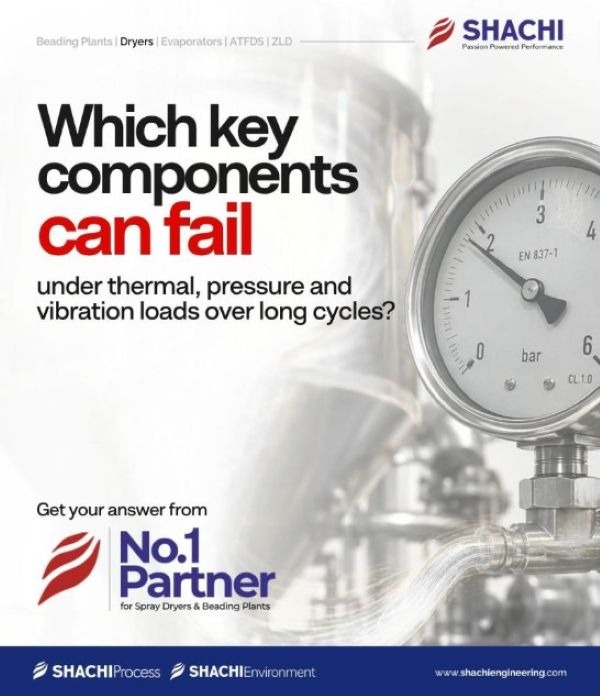
In industrial process plants, equipment is continuously exposed to thermal cycling, pressure fluctuations, mechanical vibration, and repeated operating stresses. Over time, these loads can contribute to fatigue, deformation, leakage, cracking, and premature component failure.
Understanding potential failure points during the design and engineering stage is essential for improving equipment reliability, safety, and service life.
🔹 Pressure Vessels & Process Chambers
Repeated pressure cycles can create fatigue stresses, particularly around nozzles, weld joints, and geometric discontinuities.
🔹 Heat Exchangers
Continuous heating and cooling can cause thermal expansion and contraction, potentially leading to tube fatigue, leakage, and joint failures.
🔹 Piping & Expansion Joints
Thermal movement, pressure fluctuations, and vibration can place additional stress on piping connections, supports, bends, and expansion joints.
🔹 Rotating Equipment
Pumps, blowers, fans, and other rotating machinery are particularly sensitive to imbalance, misalignment, resonance, and vibration-induced fatigue.
🔹 Welded Joints & Connections
Welds, nozzles, flanges, and other connections can become critical stress concentration points under repeated loading.
🔹 Supports, Skids & Structural Members
Long-term vibration and cyclic loads can lead to loosening, fatigue cracking, and structural degradation if the system is not adequately designed.
The key is not only to design for the maximum load—but to understand how the equipment behaves over thousands of operating cycles.
Through proper mechanical design, stress analysis, thermal assessment, vibration analysis, material selection, fatigue evaluation, and robust detailing, potential failure mechanisms can be identified and addressed before they become costly problems.
Design for the load. Engineer for the cycle. Build for long-term reliability.
🌐 Connect with us: https://www.shachi-engineering.com/