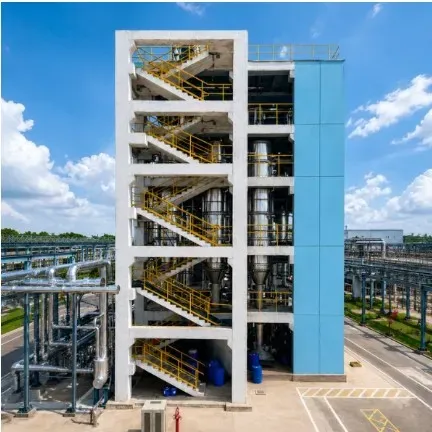
Agitated Thin Film Dryer (ATFD) | Final-Stage Drying for Concentrated Slurries, High TDS Effluent & ZLD Systems When concentrated slurry, viscous residue, high-TDS effluent, or other challenging process streams need to be converted into dry or near-dry solids, conventional drying methods can often face significant operational limitations. Sticky materials may adhere to heat-transfer surfaces, highly concentrated feeds can form hard deposits, and viscous products may be difficult to circulate or distribute evenly. An Agitated Thin Film Dryer (ATFD) is specifically designed to handle these demanding applications. The system continuously spreads the incoming feed into a thin, rapidly renewed film over a heated cylindrical surface. A rotating agitator maintains the film, promotes continuous mixing, and helps prevent excessive buildup on the heat-transfer surface. This creates an efficient and controlled drying environment, allowing moisture to be removed progressively while the concentrated material moves through the dryer toward the solids discharge. How the Process Works The concentrated feed enters the dryer and is distributed along the heated internal surface. A high-speed or suitably designed rotating agitator continuously spreads and renews the material as a thin film. Because the product remains in close contact with the heated surface, heat can be transferred efficiently into the feed. As moisture evaporates, the material becomes progressively more concentrated and eventually forms a dry or semi-dry solid. The agitator continuously moves the material forward while breaking up deposits and maintaining an active heat-transfer surface. The resulting dried material can then be discharged for further handling, cooling, packaging, disposal, recovery, or downstream processing. Designed for Difficult Industrial Feeds One of the major advantages of ATFD technology is its ability to process feeds that can be difficult to handle using conventional dryers. These may include: 1.High-TDS wastewater concentrates 2.RO and MEE evaporator rejects 3.Concentrated industrial effluents 4.Chemical and specialty chemical residues 5.Pharmaceutical process residues 6.Concentrated slurries 7.Mother liquors 8.Sticky and viscous products 9.Salt-rich streams 10.Scaling and crystallizing materials 11.Zero Liquid Discharge (ZLD) concentrates 12.High-solids process streams 13.Better Heat Transfer Through Thin-Film Operation In conventional drying systems, thick layers of material can develop on the heating surface, increasing thermal resistance and reducing drying efficiency. ATFD technology addresses this challenge by continuously maintaining a thin layer of material. The thin film provides a relatively short path for heat to travel through the product, supporting efficient heat transfer and faster moisture removal. Continuous agitation also helps expose fresh material to the heated surface, maintaining more consistent drying conditions. The actual heat-transfer performance depends on feed properties, operating temperature, viscosity, solids concentration, and system configuration, but the thin-film principle is particularly valuable for difficult-to-dry materials. Continuous Agitation for Reliable Operation The agitator is a critical part of the ATFD design. It continuously renews the product film, moves the material through the dryer, and helps control the formation of deposits. For feeds that tend to become sticky, viscous, or crystalline during concentration, maintaining movement across the heated surface can significantly improve operational reliability compared with static or poorly mixed drying arrangements. As the feed becomes progressively drier, the agitator also assists in transporting the resulting solids toward the discharge section. Controlled Final Drying ATFD systems can be designed to achieve a defined final moisture or dryness level according to the application requirement. Operating parameters such as heating-medium temperature, feed rate, vacuum level where applicable, residence time, agitator speed, and feed concentration can be optimized to achieve the required drying performance. This provides better control over the transition from concentrated liquid or slurry to dry or semi-dry solids.

Pune
08048128705
+917558636100
 Chat with us
 Chat with us