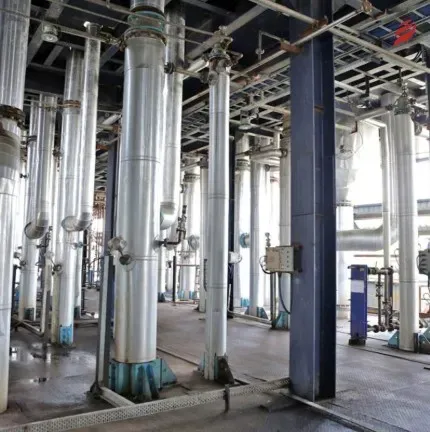
Multi effect evaporator plant | Multi-Effect Evaporator (MEE) | Energy-Efficient Concentration for Process & ETP Concentrate industrial liquids, process streams, and effluents with reduced steam consumption using Shachi’s Multi Effect Evaporator (MEE) plants. Designed for continuous industrial operation, MEE technology makes effective use of the heat already generated within the evaporation process, allowing industries to achieve the desired concentration while reducing dependence on fresh steam. A Multi Effect Evaporator consists of multiple evaporation stages, known as effects, operating at progressively lower pressures and boiling temperatures. Vapour generated in one effect is reused as the heating medium for the next effect. This cascading use of vapour allows the same thermal energy to be utilized multiple times, significantly improving the overall efficiency of the evaporation process. How Multi Effect Evaporation Works The feed enters the first effect, where heat from fresh steam or another suitable heating source causes a portion of the water to evaporate. The vapour generated from this first effect is not simply discharged. Instead, it is directed to the heating side of the second effect. Because the second effect operates at a lower pressure, the liquid inside it boils at a lower temperature. The vapour from the first effect can therefore provide the required heating energy. The same principle continues through subsequent effects: 1.Fresh steam supplies heat to the first effect. 2.Vapour generated in the first effect heats the second effect. 3.Vapour from the second effect heats the third effect. 4.The process continues through the remaining effects. 5.The final concentrated product is discharged from the last stage. By reusing vapour across multiple stages, the MEE plant can achieve a higher evaporation capacity for a given amount of fresh steam compared with a single-effect evaporator. Why Multiple Effects Reduce Steam Consumption In a conventional single-effect evaporator, a large amount of the heat supplied to evaporate water is effectively used only once. In an MEE, the vapour produced during evaporation becomes a useful source of heating energy for the next effect. This heat-reuse principle improves the steam economy of the system. The number of effects, operating temperatures, feed characteristics, evaporation duty, and system configuration determine the actual steam consumption and energy performance. For industries handling large volumes of liquid that require continuous concentration, this can translate into significant savings in thermal energy and operating costs. Designed for Industrial and Wastewater Applications Shachi MEE systems can be engineered for a wide range of applications where water needs to be removed and dissolved solids or valuable components need to be concentrated. Typical applications include: 1.Industrial wastewater concentration 2.High-TDS effluent treatment 3.Chemical and specialty chemical processes 4.Pharmaceutical process streams 5.Textile and dyeing effluents 6.Food and beverage concentration 7.Salt and chemical recovery 8.Process liquor concentration 9.RO reject concentration 10.ZLD system applications 11.Mother liquor and recycle-stream concentration 12.Application-Specific Evaporator Design Every feed behaves differently during evaporation. Some streams may be highly viscous, while others may have a high scaling tendency, foaming behaviour, suspended solids, or heat-sensitive components. Shachi designs MEE plants around the actual characteristics of the feed and the required process outcome. Important considerations include: 1.Feed flow rate 2.Initial and final solids concentration 3.TDS and dissolved salt composition 4.COD and organic content 5.Viscosity 6.Scaling and fouling tendency 7.Foaming characteristics 8.Heat sensitivity 9.Required evaporation capacity 10.Desired final concentration 11.Available steam pressure 12.Cooling-water availability 13.Condensate requirements 14.Plant layout and available space This approach helps ensure that the evaporator configuration, number of effects, heat-transfer arrangement, circulation system, and operating conditions are matched to the application.

Pune
08048128705
+917558636100
 Chat with us
 Chat with us