Nairobi, Kenya
08048073260
+917030470233

industrial evaporators

6814772a5d263414004dd4a4 Card 2

product image
Industrial Evaporators

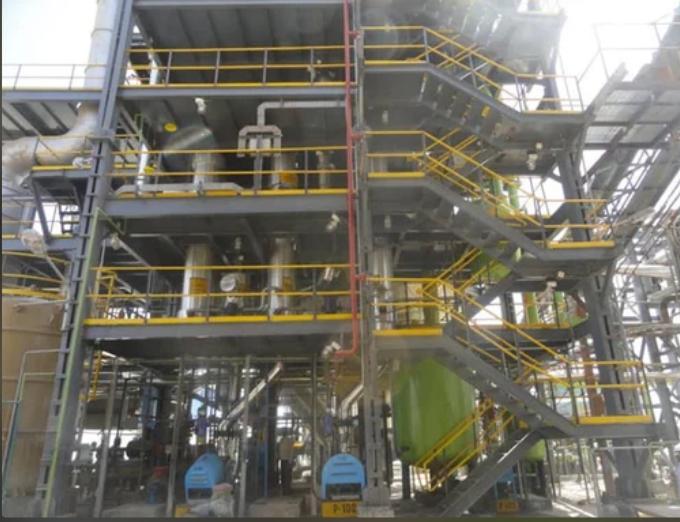
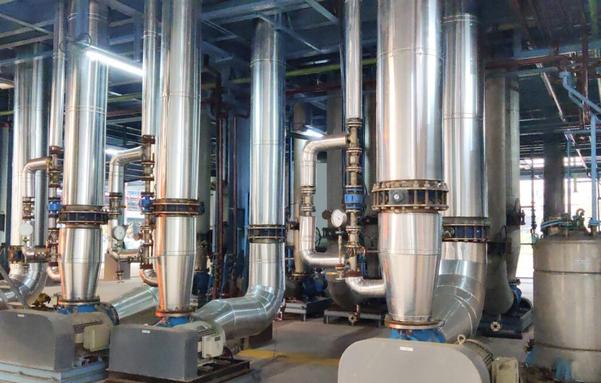
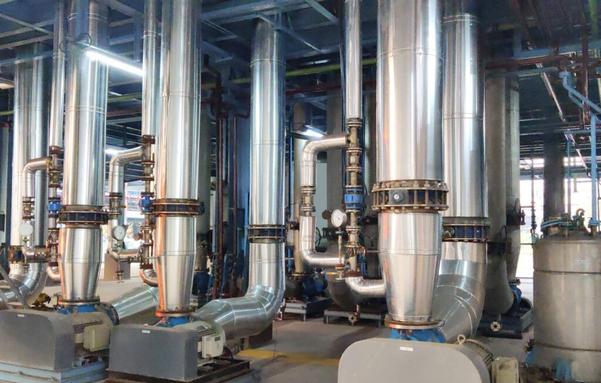
The Definitive Guide to Mechanical Vapor Recompression (MVR) Evaporation: Efficiency, Engineering, and Industrial Impact In an era where industrial energy costs are soaring and sustainability mandates are tightening, Mechanical Vapor Recompression (MVR) has emerged as a transformative technology in thermal separation. By recycling latent heat that would otherwise be wasted, MVR systems represent the pinnacle of energy-efficient evaporation. 1. Understanding MVR Evaporation: The “Energy Recycling“ Revolution Mechanical Vapor Recompression (MVR) is an advanced evaporation process that utilizes a mechanical compressor or high-pressure fan to recompress the vapor generated during the boiling process. The Core Concept In conventional multi-effect evaporators, steam is used to boil the liquid, and the resulting vapor is either sent to a condenser or used in a subsequent stage. In an MVR system, this secondary vapor is not discarded. Instead, it is mechanically compressed. This compression increases the vapor's pressure and, consequently, its saturation temperature. This “upgraded“ vapor is then returned to the heat exchanger (calandria) to act as the primary heating medium for the same process. This creates a closed-loop thermal cycle where the latent heat of the vapor is fully recovered. The Working Principle: Physics of Vapor CompressionThe efficiency of MVR evaporation is rooted in the principle of thermodynamics, specifically the relationship between pressure and temperature in saturated steam. The Four-Step Cycle 1 Evaporation: The feed liquid is heated to its boiling point in the calandria. As it boils, it generates low-pressure secondary steam. 2 Separation: The mixture of vapor and liquid enters a Vapor-Liquid Separator (VLS). The liquid (concentrate) is collected, while the “clean“ vapor is drawn toward the compressor. 3 Compression: The heart of the MVR system—the compressor or turbofan—mechanically increases the vapor's pressure. This work adds enthalpy to the steam, raising its temperature by 6o C to 20o C (depending on the compression ratio). 4 Heat Exchange: This high-temperature compressed vapor is fed back into the shell side of the calandria. It condenses on the outer surface of the tubes, transferring its latent heat back to the feed liquid. Key Components of an MVR Plant A. The Vapor Compressor The compressor is the most critical and expensive component. Centrifugal Fans (Turbofans): Ideal for high vapor volumes with moderate temperature increases. They are highly efficient but sensitive to impeller fouling. Roots Blowers: Best for smaller capacities or applications requiring a high compression ratio ($Delta P$). They are robust and handle fluctuating loads well. B. The Calandria (Heat Exchanger)Depending on the fluid properties, MVR systems typically use: Falling Film Evaporators: Ideal for low-viscosity, heat-sensitive fluids. The liquid forms a thin film inside the tubes, allowing for high heat transfer with a low $Delta T$.Forced Circulation Evaporators: Used for high-viscosity fluids or liquids prone to scaling and crystallization. High-velocity pumps keep the liquid moving to prevent fouling. C. Vapor-Liquid Separator High-efficiency mist eliminators (demisters) are essential to ensure the vapor reaching the compressor is free of liquid droplets, which could erode the high-speed impellers. The Economic Edge: MVR vs. Multi-Effect Evaporators (MEE)Why are industries switching from MEE to MVR? OPEX Reduction: While an MEE requires constant live steam (which is expensive to generate), an MVR runs on electricity. The energy required to compress vapor is roughly $5%$ to $10%$ of the energy required to generate fresh steam. No Cooling Water: Since the vapor is condensed by the feed liquid itself, MVR systems eliminate the need for massive cooling towers and circulating water pumps. Carbon Footprint: Because MVR relies on electricity (which can be sourced from renewables), it allows factories to move away from coal or gas-fired boilers, significantly lowering $text{CO}_2$ emissions.

6814772a5d263414004dd4a4 Card 2

product image
Industrial Evaporators

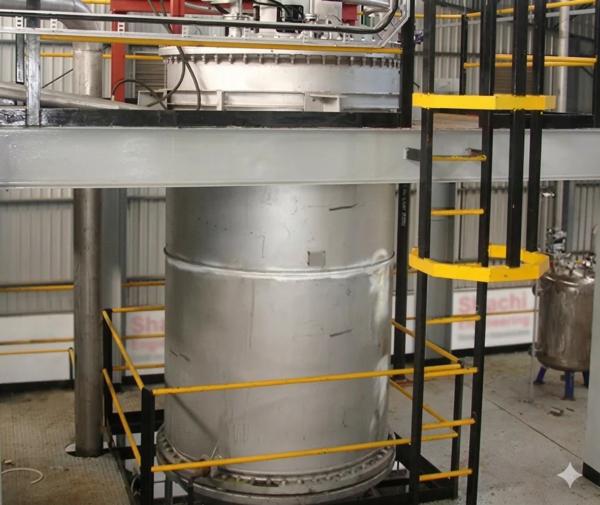
In the modern industrial landscape, the challenge of processing heat-sensitive, high-viscosity, or fouling-prone fluids is a constant hurdle. Traditional evaporation methods often fall short, leading to product degradation or frequent maintenance shutdowns. The Agitated Thin Film Evaporator (ATFE) has emerged as the gold standard for these demanding applications. In this comprehensive guide, we explore why ATFE technology is indispensable, how it operates under vacuum conditions, and the specific engineering advantages it offers for the chemical, pharmaceutical, and food industries. 1. What is an Agitated Thin Film Evaporator? An Agitated Thin Film Evaporator is a specialized heat exchanger designed to facilitate the rapid evaporation of volatile components from a liquid feed. Unlike falling film or climbing film evaporators, the ATFE utilizes a mechanical rotor system to physically spread the liquid across the heating surface. This mechanical agitation creates a highly turbulent, thin film (often less than 1mm thick), which maximizes heat transfer and minimizes the residence time—the “secret sauce“ for handling delicate materials. 2. Benefits of ATFE TechnologyHigh Heat Transfer Rates The core advantage of an ATFE is its Overall Heat Transfer Coefficient (U). By mechanically agitating the liquid, the sensor breaks the stagnant boundary layer that typically inhibits heat flow. This allows for rapid evaporation even with a small temperature difference ($Delta T$). Mitigation of Fouling and Scaling Fouling is the enemy of industrial efficiency. In an ATFE, the rotor blades act as “wipers“ or “scrapers“ that constantly renew the film. This prevents the build-up of solids or “baking“ on the heated walls, which is common in stationary evaporators processing viscous resins or polymers. Precise Control and Low Residence Time. Product degradation occurs when a substance is exposed to high temperatures for too long. ATFE systems offer a residence time measured in seconds, not minutes. This “flash“ evaporation ensures the thermal history of the product remains minimal. Versatility in High Vacuum Operations. ATFE systems are often designed to operate under deep vacuum. By reducing the pressure, the boiling point of the liquid is lowered significantly. This is a critical benefit for the pharmaceutical industry, where active ingredients might break down at atmospheric boiling points. 3. Working Principle: The Science of the Thin Film The efficiency of an ATFE is governed by the laws of thermodynamics and fluid mechanics. Here is the step-by-step breakdown: Feed Entry: The raw liquid enters the top of the cylindrical vertical shell. Film Formation: As the liquid enters, it meets the Rotor Assembly. The centrifugal force and the design of the blades (often “fixed clearance“ or “wiping“ types) spread the liquid into a uniform thin film. Heat Exchange: The external jacket is filled with a heating medium (Steam or Thermic Fluid). Heat conducts through the wall into the turbulent film. Vaporization: Volatile components vaporize instantly. The vapor travels upward through an internal mist eliminator to a condenser. Discharge: The concentrated, non-volatile product flows down the wall by gravity and is collected at the bottom discharge nozzle. Engineering Deep-Dive: Rotor Blade Designs The “heart“ of the ATFE is the rotor. Depending on your product's viscosity, different blade types are used: Fixed Clearance Blades: Best for low-to-medium viscosity fluids. Wiped/Scraped Surface Blades: Ideal for highly viscous or fouling-prone materials where the blade physically touches or stays extremely close to the wall. Smith Type Rotors: Designed for ultra-high-speed agitation in specific chemical reactions. Conclusion: Why Partner with Shachi Engineering? Selecting an Agitated Thin Film Evaporator is a capital investment that requires precision engineering. At Shachi Engineering, we specialize in custom-built ATFE solutions designed to maximize your yield while minimizing energy consumption. Our systems are engineered for durability, featuring precision-machined rotors and high-efficiency heating jackets.

6814772a5d263414004dd4a4 Card 2

product image
Industrial Evaporators

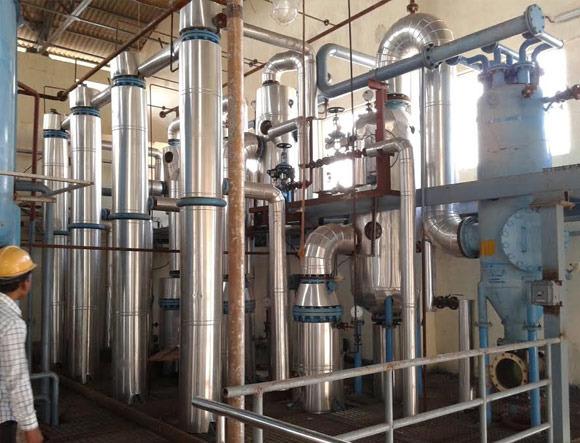
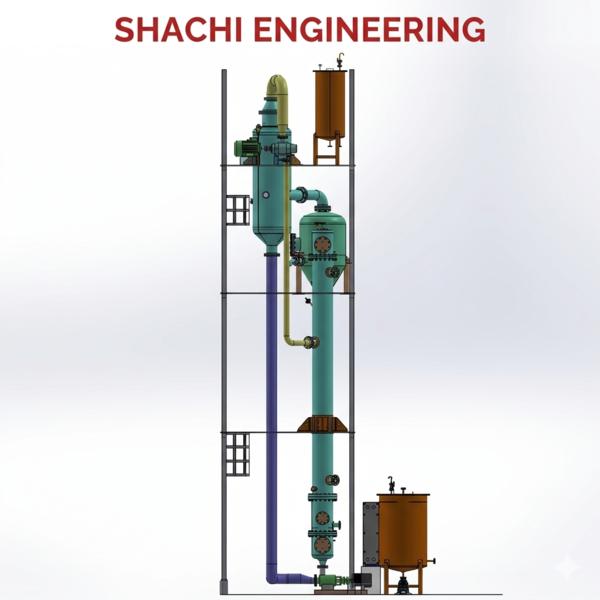
The Ultimate Guide to Falling Film Evaporators: Precision Engineering by Shachi Engineering In the sophisticated world of thermal separation, the Falling Film Evaporator (FFE) stands out as the gold standard for processing heat-sensitive liquids with maximum efficiency. As one of the top manufacturers of falling film evaporators in India, Shachi Engineering brings over twenty years of rigorous experience to the table. Our two-decade journey has endowed us with profound process expertise, enabling us to deliver world-class evaporation solutions that cater to the most critical industrial challenges. 1. What is a Falling Film Evaporator? A Falling Film Evaporator is a highly efficient heat transfer device specifically engineered to concentrate liquid solutions by evaporating the solvent. It is uniquely suited for materials that require low-temperature boiling and short residence times to maintain their chemical and nutritional integrity. The Core Working Principle The operational excellence of an FFE is based on the physics of gravity and thin-film dynamics: Uniform Distribution: The process begins at the top of the evaporator, where the liquid solution enters a specialized distributor. This component ensures the liquid is spread evenly across the top of a series of vertical tubes. Film Formation: As the liquid descends due to gravity, it forms a continuous, thin film along the inner walls of the tubes. Heat Transfer: Thermal energy is transferred from the tube wall to this thin liquid film. Because the film is so thin, the heat transfer coefficient is exceptionally high. Flash Evaporation: The heat causes the solvent to evaporate rapidly. The resulting vapor rises through the center of the tube and is collected in a vapor separator. Concentration: The remaining concentrated liquid is collected at the bottom for storage or further processing, while the film is continuously replenished from the top. 2. Strategic Benefits of Shachi Falling Film Systems Why do industry leaders choose Shachi Engineering for their evaporation needs? Our systems are designed to offer a competitive edge through: 3. Global Industrial Applications The versatility of the Falling Film Evaporator makes it an essential asset across several high-growth sectors: A. Chemical & Petrochemical Industry Purification: Used to concentrate and purify aggressive chemicals like acids, bases, and organic solvents. Refining: Integral to the refining of crude oil and various petrochemical derivatives. B. Food, Dairy & Beverage Juice Concentration: Concentrating fruit juices while preserving natural flavors and aromas. Dairy Processing: Essential for the production of condensed milk and other dairy concentrates. C. Pharmaceutical & Nutraceuticals API Concentration: Purifying Active Pharmaceutical Ingredients (APIs) where heat sensitivity is a major concern. Herbal Extracts: Maintaining the bio-activity of natural extracts during the solvent recovery process. D. Environmental & Renewable Energy Wastewater Treatment: Removing water from industrial waste to concentrate solids for eco-friendly disposal. Desalination: Producing fresh water from seawater by efficiently removing salt. Biofuels: Concentrating feedstock for the sustainable production of biofuels. 4. Why Partner with Shachi Engineering? As a leader in the Indian manufacturing landscape, Shachi Engineering combines two decades of heritage with forward-looking innovation. Process Expertise: We understand the nuances of different liquids, from high-viscosity food products to corrosive chemical bases. World-Class Quality: Our manufacturing processes adhere to the highest international standards, ensuring durability and safety. Custom Engineering: We don't believe in one-size-fits-all. Every FFE we build is customized to the client's specific temperature and pressure requirements. End-to-End Support: From the initial concept and design to site commissioning and after-sales maintenance, we are your partners in growth.

6814772a5d263414004dd4a4 Card 2

product image
Industrial Evaporators

The Ultimate Guide to Forced Circulation Evaporators: Mastering High-Fouling and Viscous Liquids In industrial processing, not all liquids are created equal. Many solutions—ranging from chemical brines to heavy fruit pulps—pose significant challenges due to their tendency to scale, foul, or become extremely viscous when heated. At Shachi Engineering, we specialize in the design and manufacture of Forced Circulation Evaporators (FCE), the heavy-duty workhorses of the evaporation world. Our Forced Circulation systems are engineered to provide a high rate of heat transfer while maintaining a low fouling rate, ensuring that your production stays consistent and your maintenance costs stay low. 1. What is a Forced Circulation Evaporator? A Forced Circulation Evaporator is a specialized thermal system that operates on the principle of continuous, high-velocity circulation of the liquid being processed. Unlike natural circulation evaporators that rely on density differences, the FCE uses a powerful pump to drive the liquid through the heat exchanger. This mechanical force ensures that the liquid remains at a velocity high enough to “scour“ the heat transfer surfaces, preventing the build-up of solids even when processing highly concentrated or abrasive materials. 2. The Working Principle: A Step-by-Step Breakdown The efficiency of a Shachi Engineering FCE plant is rooted in its precise four-stage operational cycle: Continuous Pumping & Heating: The liquid is pumped through a heat exchanger (or a series of exchangers) where it is heated by steam or another heating medium under pressure to prevent boiling inside the tubes. Flash Evaporation: The superheated liquid is directed into a flash chamber (vapor separator). As the pressure drops, the liquid “flashes“ into a boil, rapidly creating vapor. Vapor-Liquid Separation: The resulting mixture enters a vapor separator. Here, liquid droplets are stripped away, and the clean vapor is directed upward. Recirculation & Discharge: The separated vapor is typically condensed or compressed for reuse, while the concentrated liquid is either returned to the heat exchanger for further concentration or directed to a storage tank as a final product. 3. Strategic Benefits of Shachi Forced Circulation Systems Choosing a Forced Circulation Evaporator from Shachi Engineering provides several long-term operational advantages: 4. Industrial Applications: Where FCE Excellence is Required Because of their rugged design, Forced Circulation Evaporators are essential in industries where “difficult“ liquids are the norm: Chemical Industry: Used for concentrating aggressive chemical solutions, including various acids, alkalis, and salts. Wastewater Treatment & ZLD: A critical component in Zero Liquid Discharge plants to separate water from concentrated solids and impurities. Food & Beverage: Ideal for the concentration of fruit juices, dairy products, and high-solids food items. Pharmaceuticals: Used for the precise concentration of medicinal extracts and temperature-sensitive solutions. Petrochemicals: Handling the concentration of various hydrocarbons and complex petrochemical byproducts. 5. Why Partner with Shachi Engineering? As a leading manufacturer in India with a global footprint, Shachi Engineering doesn't just provide equipment—we provide a performance guarantee. Our Forced Circulation Evaporators are designed to maximize plant uptime and provide a high return on investment (ROI) through: Custom Metallurgy: We use SS316L, Duplex, or exotic alloys to handle corrosive feeds. Advanced Automation: Fully integrated PLC/SCADA systems for precise control over flow rates and temperatures. Maintenance-First Design: Easy access points for inspection and minimal wear-and-tear components.

6814772a5d263414004dd4a4 Card 2

product image
Industrial Evaporators

The Future of Zero-Fouling: Self-Cleaning Heat Exchanger & Evaporator Technology by Shachi Engineering In the high-stakes world of industrial processing, “fouling“ is the silent thief of profitability. Whether it is mineral scaling, organic growth, or chemical byproduct buildup, fouling creates a thermal barrier that forces boilers to work harder, drives up energy bills, and eventually brings production to a grinding halt for manual cleaning. At Shachi Engineering, we believe you shouldn't have to stop production to maintain it. Through our exclusive partnership with Netherlands-based Klaren International BV, we are bringing revolutionary Self-Cleaning Heat Exchanger Technology to the Indian market. This system doesn't just manage fouling—it eliminates it. 1. What is Self-Cleaning Technology? Developed by Klaren International BV and delivered in India by Shachi Engineering, this technology uses a fluidized bed of cleaning particles within the heat exchanger tubes. As the process fluid flows upward, it carries small ceramic or metal particles that constantly “scour“ the internal walls of the tubes. The Operating Principle Continuous Scouring: The fluidized particles create a mild abrasive effect that removes the boundary layer where fouling usually begins. Enhanced Turbulence: The movement of these particles increases the turbulence of the fluid, which actually improves the heat transfer coefficient beyond that of a standard exchanger. Online Operation: The cleaning happens while the machine is running. There is no need to bypass the system or shut down for high-pressure water jetting. 3. Maximizing ROI with Mechanical Vapor Recompression (MVR) To achieve the pinnacle of energy efficiency, Shachi Engineering integrates Self-Cleaning technology with Mechanical Vapor Recompression (MVR). How MVR Saves 41% of Primary Energy: In a standard evaporator, latent heat is often lost during condensation. With MVR: The vapor produced is compressed to increase its pressure and temperature. This “upgraded“ vapor is then fed back into the shell side of the heat exchanger. The latent heat is recovered, reducing the dependence on fresh steam by approximately 41%. 4. Industrial Applications: Where Self-Cleaning Wins This technology is a game-changer for industries dealing with “difficult“ fluids that are prone to rapid scaling: A. Effluent Treatment Plants (ETP) In Zero Liquid Discharge (ZLD) systems, high-salt brines often scale up traditional evaporators within days. Our self-cleaning technology keeps these systems running indefinitely, even with high-silica or calcium-rich wastewater. B. Chemical & Petrochemical Ideal for handling polymers, resins, and oil-based fluids where traditional cleaning is labor-intensive and hazardous. C. Food & Beverage Concentrating juices, dairy, or distillery spent wash often results in organic fouling. Self-cleaning technology maintains hygiene and constant throughput without chemical interference. D. Oil, Gas & Mining Processing produced water or mineral slurries requires robust equipment that can withstand abrasive and scaling environments. 5. From Revamp to New Installations Whether you are designing a new “Greenfield“ project or struggling with an existing “Brownfield“ plant that requires cleaning every week, Shachi Engineering provides: New Plant Design: Optimized, compact systems designed with zero-fouling logic from day one. Revamp Services: We can often retrofit your existing heat exchangers with Klaren self-cleaning technology to restore lost capacity. 6. Conclusion: A Partnership for the Future By combining the Dutch innovation of Klaren International with the local manufacturing and commissioning expertise of Shachi Engineering, we provide Indian industries with a path to “Maintenance-Free“ evaporation. Save on maintenance, increase your uptime, and join the ranks of global leaders moving toward sustainable, continuous production. Strategic Benefits: The Shachi-Klaren Advantage

6814772a5d263414004dd4a4 Card 2

product image
Industrial Evaporators

The Future of Zero-Fouling: Self-Cleaning Heat Exchanger & Evaporator Technology by Shachi Engineering In the high-stakes world of industrial processing, “fouling“ is the silent thief of profitability. Whether it is mineral scaling, organic growth, or chemical byproduct buildup, fouling creates a thermal barrier that forces boilers to work harder, drives up energy bills, and eventually brings production to a grinding halt for manual cleaning. At Shachi Engineering, we believe you shouldn't have to stop production to maintain it. Through our exclusive partnership with Netherlands-based Klaren International BV, we are bringing revolutionary Self-Cleaning Heat Exchanger Technology to the Indian market. This system doesn't just manage fouling—it eliminates it. 1. What is Self-Cleaning Technology? Developed by Klaren International BV and delivered in India by Shachi Engineering, this technology uses a fluidized bed of cleaning particles within the heat exchanger tubes. As the process fluid flows upward, it carries small ceramic or metal particles that constantly “scour“ the internal walls of the tubes. The Operating Principle Continuous Scouring: The fluidized particles create a mild abrasive effect that removes the boundary layer where fouling usually begins. Enhanced Turbulence: The movement of these particles increases the turbulence of the fluid, which actually improves the heat transfer coefficient beyond that of a standard exchanger. Online Operation: The cleaning happens while the machine is running. There is no need to bypass the system or shut down for high-pressure water jetting. 3. Maximizing ROI with Mechanical Vapor Recompression (MVR) To achieve the pinnacle of energy efficiency, Shachi Engineering integrates Self-Cleaning technology with Mechanical Vapor Recompression (MVR). How MVR Saves 41% of Primary Energy: In a standard evaporator, latent heat is often lost during condensation. With MVR: The vapor produced is compressed to increase its pressure and temperature. This “upgraded“ vapor is then fed back into the shell side of the heat exchanger. The latent heat is recovered, reducing the dependence on fresh steam by approximately 41%. 4. Industrial Applications: Where Self-Cleaning Wins This technology is a game-changer for industries dealing with “difficult“ fluids that are prone to rapid scaling: A. Effluent Treatment Plants (ETP) In Zero Liquid Discharge (ZLD) systems, high-salt brines often scale up traditional evaporators within days. Our self-cleaning technology keeps these systems running indefinitely, even with high-silica or calcium-rich wastewater. B. Chemical & Petrochemical Ideal for handling polymers, resins, and oil-based fluids where traditional cleaning is labor-intensive and hazardous. C. Food & Beverage Concentrating juices, dairy, or distillery spent wash often results in organic fouling. Self-cleaning technology maintains hygiene and constant throughput without chemical interference. D. Oil, Gas & Mining Processing produced water or mineral slurries requires robust equipment that can withstand abrasive and scaling environments. 5. From Revamp to New Installations Whether you are designing a new “Greenfield“ project or struggling with an existing “Brownfield“ plant that requires cleaning every week, Shachi Engineering provides: New Plant Design: Optimized, compact systems designed with zero-fouling logic from day one. Revamp Services: We can often retrofit your existing heat exchangers with Klaren self-cleaning technology to restore lost capacity. 6. Conclusion: A Partnership for the Future By combining the Dutch innovation of Klaren International with the local manufacturing and commissioning expertise of Shachi Engineering, we provide Indian industries with a path to “Maintenance-Free“ evaporation. Save on maintenance, increase your uptime, and join the ranks of global leaders moving toward sustainable, continuous production. Strategic Benefits: The Shachi-Klaren Advantage

6814772a5d263414004dd4a4 Card 2

product image
Industrial Evaporators

A Multi-Effect Evaporator (MEE) is a sophisticated thermal system designed to concentrate a liquid solution by evaporating the solvent (usually water) through a sequence of vessels called “effects.“The core innovation of an MEE lies in its ability to reuse the latent heat of vapor. In a single-effect system, the vapor generated is typically wasted or condensed using external cooling. In an MEE, the vapor from the first effect acts as the heating medium for the second effect, which operates at a lower pressure and temperature. This “cascading“ energy reuse makes it the gold standard for energy-efficient industrial concentration.2. Operating Mechanisms: Feed ConfigurationsAt Shachi Engineering, we customize the flow pattern based on the viscosity and thermal sensitivity of your product.A. Forward Feed ConfigurationIn this setup, both the feed and the steam flow in the same direction (from Effect 1 to Effect n).Process: Raw feed enters the first effect (highest pressure/temperature) and moves toward the vacuum end.Advantage: Since the liquid moves due to pressure differences, pumping requirements are minimized.Best For: Highly concentrated products that might be damaged by high heat at high viscosities.B. Backward Feed ConfigurationThe feed enters the last (coldest) effect and is pumped “backward“ toward the first (hottest) effect.Process: Liquid moves against the pressure gradient, requiring pumps between each stage.Advantage: This is ideal for cold feeds or viscous liquids. As the concentration increases, the temperature also increases, which helps maintain a manageable viscosity.Best For: Solutions where viscosity rises sharply with concentration.C. Mixed and Parallel FeedUsed in specialized chemical processing where specific effects require different residence times or concentration levels. 4. Specialized Types of Evaporators Depending on the fluid dynamics and fouling tendencies, Shachi Engineering manufactures several variants: Falling Film Evaporator: Best for heat-sensitive liquids; features high heat transfer coefficients and low residence time. Forced Circulation Evaporator: Essential for liquids prone to scaling or salting (e.g., wastewater brines). Agitated Thin Film Evaporator (ATFE): Used for extremely high-viscosity or heat-sensitive materials. MVR (Mechanical Vapor Recompression): Uses a compressor to upgrade vapor energy, often eliminating the need for a constant steam source. 5. Global Applications & Market Relevance Shachi Engineering serves a diverse global clientele, focusing on high-growth industrial hubs. A. Desalination and Water Scarcity In regions like the Middle East and coastal India (Chennai, Gujarat), MEE is the backbone of producing potable water from seawater, offering a sustainable alternative to traditional RO systems in high-fouling environments. B. Food & Dairy Industry We provide specialized MEEs for: Milk & Whey Concentration: Essential for dairy hubs in Punjab and Maharashtra. Fruit Juice & Puree: Preserving the “fresh-from-the-farm“ taste for global export. C. Chemical & Pharmaceutical Processing Concentration of dyes, intermediates, and APIs. Our systems are designed for Solvent Recovery, helping plants in Hyderabad and Ahmedabad reduce raw material waste. D. Zero Liquid Discharge (ZLD) With tightening environmental laws in cities like Delhi and Bengaluru, our MEEs serve as the “heart“ of ZLD plants, concentrating hazardous waste into a manageable slurry for final drying.

Phone Number

08048073260

Please keep 0 before dialling the number.

Mon-Thu: 10 AM - 2 PM • Fri: 3 PM - 7AM

Other Website Visit our other website
Address Nairobi , Nairobi County , Kenya

Nairobi, Kenya, Kenya, 100