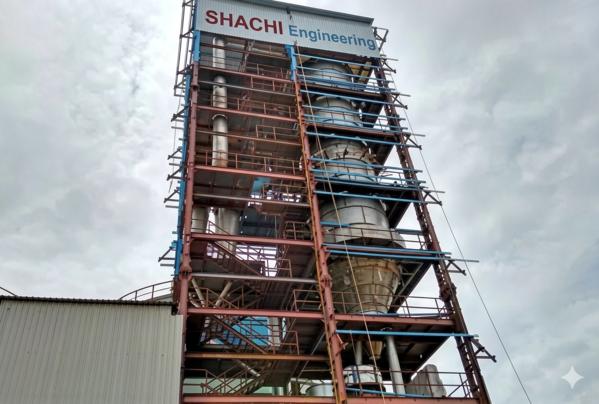
In the specialized world of chemical processing, converting molten liquids into uniform, free-flowing solid beads is a critical step for downstream packaging and application. Spray Cooling, also known as Spray Congealing or Beading, is the technology of choice for materials that melt at manageable temperatures but require a high degree of particle uniformity. This guide explores the engineering behind Shachi Engineering’s advanced spray cooling systems, designed specifically for the rigorous demands of fatty acid and castor oil derivatives. What is Spray Cooling (Congealing)? Spray cooling is a thermal process where a molten raw material is transformed into solid, spherical granules or beads through contact with chilled air. Unlike spray drying, which removes moisture through evaporation, spray congealing involves a phase change from liquid to solid without the removal of mass. The Significance of Spherical Morphology The goal of a beading plant is to produce particles with excellent flowability. Spherical beads (ranging from 300 to 1000 microns) minimize dust, prevent caking, and allow for precise dosing in secondary manufacturing processes. The Operating Principle: From Melt to Bead The efficiency of a congealing plant depends on the precise intersection of fluid dynamics and thermodynamics. Step 1: Molten Feed and Atomization The process begins with the raw material in a molten state. This liquid is pumped to the top of the spray chamber, where it is atomized. The design of the nozzles is the most critical factor here. Shachi Engineering utilizes a meticulous distribution pattern to ensure that the initial droplets are uniform in size. Step 2: Heat Exchange with Chilled Air A stream of equally distributed cold air is introduced into the chamber. As the molten droplets fall through this cold air stream, they lose heat. Because the air is significantly cooler than the melting point of the material, the droplets solidify rapidly as they descend. Step 3: Collection and Fines Separation The bulk of the solidified granules are collected at the bottom of the chamber. However, smaller “fines“ are often carried by the exhaust air. These are captured using a high-efficiency cyclone separator and returned to the system, ensuring zero waste. Step 4: Post-Cooling and Lump Prevention One of the unique features of a high-end system is the Integrated Fluidized Bed Cooler. Even after solidifying, beads can retain internal heat. If packaged immediately, this latent heat can cause “clumping“ or “lump formation.“ Our systems pass the beads through an external vibratory fluidized bed cooler to ensure they reach ambient temperature before shipment. Why Shachi’s Design Sets the Industry Standard Meticulous Nozzle Engineering: Standard spray coolers often suffer from “wall sticking,“ where molten material hits the chamber sides before solidifying. Our distribution pattern is engineered to keep the spray envelope away from the walls, increasing uptime and reducing cleaning frequency. Energy-Efficient Evaporative CoolingBy optimizing the air-to-liquid ratio, our systems utilize the minimum energy required to achieve the necessary $Delta T$ (temperature difference). This makes our plants significantly more cost-effective to run over a 24/7 production cycle. Balanced Airflow System The system is governed by two statically and dynamically balanced fans—the Delivery Blower and the Exhaust Blower. This “push-pull“ arrangement maintains a precise pressure balance within the chamber, ensuring the residence time of the particles is exactly what the thermodynamics require. Applications: Diverse Product Compatibility Spray congealing is the ideal solution for various fatty acids and esters. Fatty Acid Derivatives Stearic Acid (C18): Widely used in cosmetics and industrial lubricants. Palmitic (C16) & Lauric (C12) Acids: Essential for soaps and detergents. Hydrogenated Palm Stearin (HPS): Used in the food industry for shortenings. Castor Oil Derivatives 12-HSA (12-Hydroxy Stearic Acid): A key ingredient in high-performance greases. Hydrogenated Castor Oil (HCO): Used as a rheology modifier in paints and coatings. Specialty Applications GMS (Glycerol Monostearate): An emulsifier used heavily in food and plastic processing. Animal Feed Encapsulation: Ensuring nutrients are delivered in a stable, bead-sized format. Advanced Configuration: Open vs. Closed Loop Open-Loop Systems Used for stable products where ambient air (filtered and chilled) can be used for cooling. This is the most common and cost-effective setup for fatty acids. Closed-Loop Systems For products that are sensitive to oxygen or are highly volatile, the system can be operated in a closed loop using an inert gas like Nitrogen. This prevents oxidation and ensures the highest product purity.

Dubai, United Arab Emirates
08048066715
+917030470233
 Chat with us
 Chat with us