
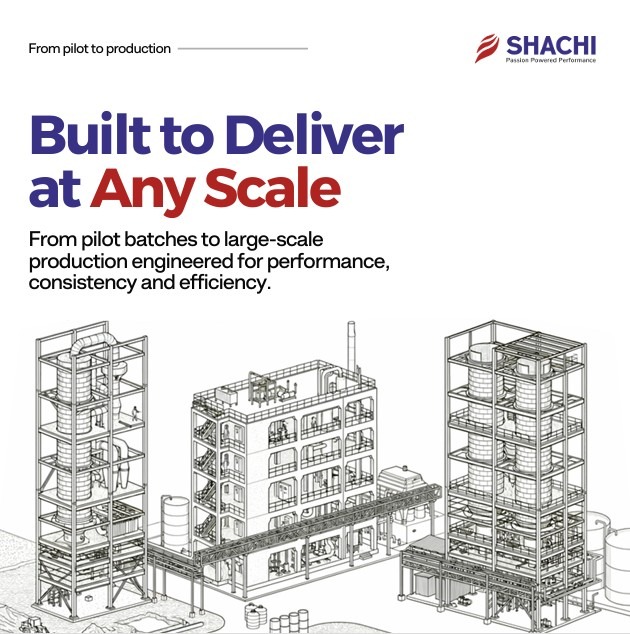
As production demands increase, scaling up is not simply about handling higher capacity. True industrial scale-up means maintaining the same product quality, process efficiency, and operational stability from pilot trials to commercial manufacturing.
A successful scale-up strategy ensures that every stage of production performs consistently whether operating at laboratory scale, pilot scale, or full industrial throughput.
Why Scale-Up Matters
Many processes perform well during pilot testing but face challenges during commercial production due to changes in:
- Heat transfer
- Drying efficiency
- Flow dynamics
- Particle formation
- Process control
- Energy consumption
Without proper engineering, increasing throughput can directly impact product consistency and plant efficiency.
Key Factors in Successful Scale-Up
- Process Consistency Maintaining uniform product characteristics such as:
- Moisture content Particle size Bulk density Solubility Product stability
- Thermal & Drying Performance Optimizing heat and mass transfer to ensure efficient drying without affecting product quality.
- Automation & Process Control Advanced control systems help maintain stable operating conditions across varying production loads.
- Energy Efficiency Well-designed systems reduce operating costs while maximizing production output.
- Pilot Validation Pilot-scale trials help validate process parameters before full-scale implementation, reducing technical risk and improving commercial readiness. From Pilot Trials to Commercial Success A reliable scale-up approach bridges the gap between R&D and industrial production.
By combining pilot testing, process engineering, and performance validation, manufacturers can confidently move toward large-scale operations while maintaining quality and efficiency.
The goal is not just bigger production it is scalable performance that delivers consistent results at every stage of growth.