

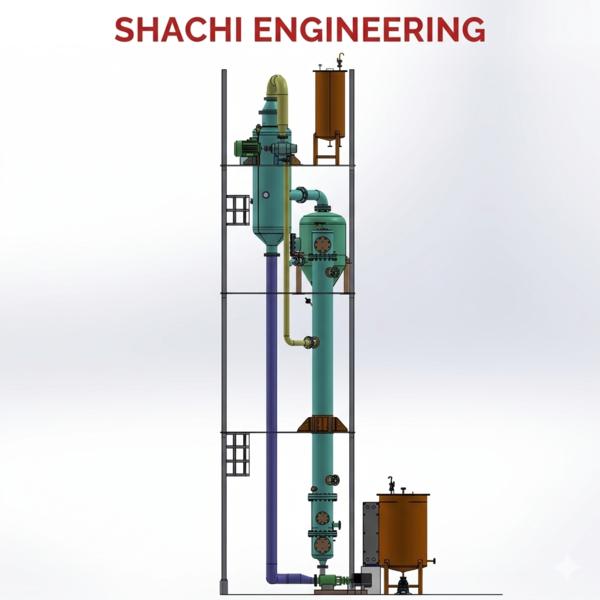
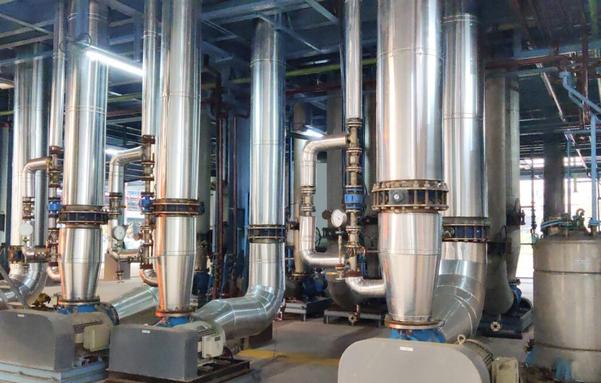
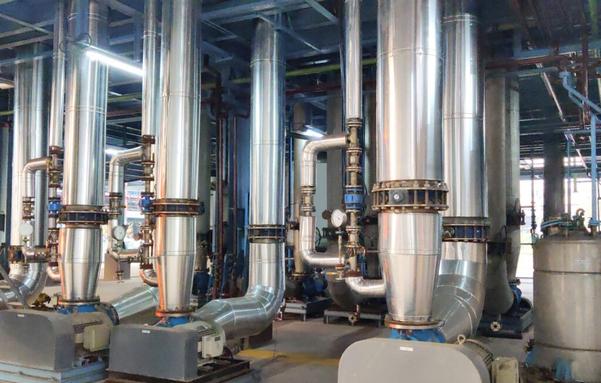
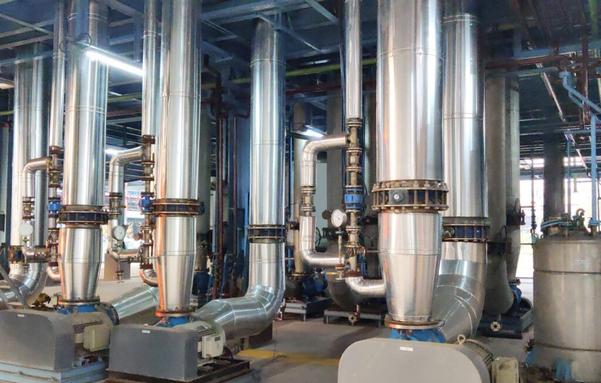
The Definitive Guide to Mechanical Vapor Recompression (MVR) Evaporation: Efficiency, Engineering, and Industrial Impact In an era where industrial energy costs are soaring and sustainability mandates are tightening, Mechanical Vapor Recompression (MVR) has emerged as a transformative technology in thermal separation. By recycling latent heat that would otherwise be wasted, MVR systems represent the pinnacle of energy-efficient evaporation. 1. Understanding MVR Evaporation: The “Energy Recycling“ Revolution Mechanical Vapor Recompression (MVR) is an advanced evaporation process that utilizes a mechanical compressor or high-pressure fan to recompress the vapor generated during the boiling process. The Core Concept In conventional multi-effect evaporators, steam is used to boil the liquid, and the resulting vapor is either sent to a condenser or used in a subsequent stage. In an MVR system, this secondary vapor is not discarded. Instead, it is mechanically compressed. This compression increases the vapor's pressure and, consequently, its saturation temperature. This “upgraded“ vapor is then returned to the heat exchanger (calandria) to act as the primary heating medium for the same process. This creates a closed-loop thermal cycle where the latent heat of the vapor is fully recovered. The Working Principle: Physics of Vapor CompressionThe efficiency of MVR evaporation is rooted in the principle of thermodynamics, specifically the relationship between pressure and temperature in saturated steam. The Four-Step Cycle 1 Evaporation: The feed liquid is heated to its boiling point in the calandria. As it boils, it generates low-pressure secondary steam. 2 Separation: The mixture of vapor and liquid enters a Vapor-Liquid Separator (VLS). The liquid (concentrate) is collected, while the “clean“ vapor is drawn toward the compressor. 3 Compression: The heart of the MVR system—the compressor or turbofan—mechanically increases the vapor's pressure. This work adds enthalpy to the steam, raising its temperature by 6o C to 20o C (depending on the compression ratio). 4 Heat Exchange: This high-temperature compressed vapor is fed back into the shell side of the calandria. It condenses on the outer surface of the tubes, transferring its latent heat back to the feed liquid. Key Components of an MVR Plant A. The Vapor Compressor The compressor is the most critical and expensive component. Centrifugal Fans (Turbofans): Ideal for high vapor volumes with moderate temperature increases. They are highly efficient but sensitive to impeller fouling. Roots Blowers: Best for smaller capacities or applications requiring a high compression ratio ($Delta P$). They are robust and handle fluctuating loads well. B. The Calandria (Heat Exchanger)Depending on the fluid properties, MVR systems typically use: Falling Film Evaporators: Ideal for low-viscosity, heat-sensitive fluids. The liquid forms a thin film inside the tubes, allowing for high heat transfer with a low $Delta T$.Forced Circulation Evaporators: Used for high-viscosity fluids or liquids prone to scaling and crystallization. High-velocity pumps keep the liquid moving to prevent fouling. C. Vapor-Liquid Separator High-efficiency mist eliminators (demisters) are essential to ensure the vapor reaching the compressor is free of liquid droplets, which could erode the high-speed impellers. The Economic Edge: MVR vs. Multi-Effect Evaporators (MEE)Why are industries switching from MEE to MVR? OPEX Reduction: While an MEE requires constant live steam (which is expensive to generate), an MVR runs on electricity. The energy required to compress vapor is roughly $5%$ to $10%$ of the energy required to generate fresh steam. No Cooling Water: Since the vapor is condensed by the feed liquid itself, MVR systems eliminate the need for massive cooling towers and circulating water pumps. Carbon Footprint: Because MVR relies on electricity (which can be sourced from renewables), it allows factories to move away from coal or gas-fired boilers, significantly lowering $text{CO}_2$ emissions.
Address
Abuja , Abuja Municipal Area Council , Federal Capital Territory
Abuja, Nigeria, Nigeria, 900001